What you'll learn
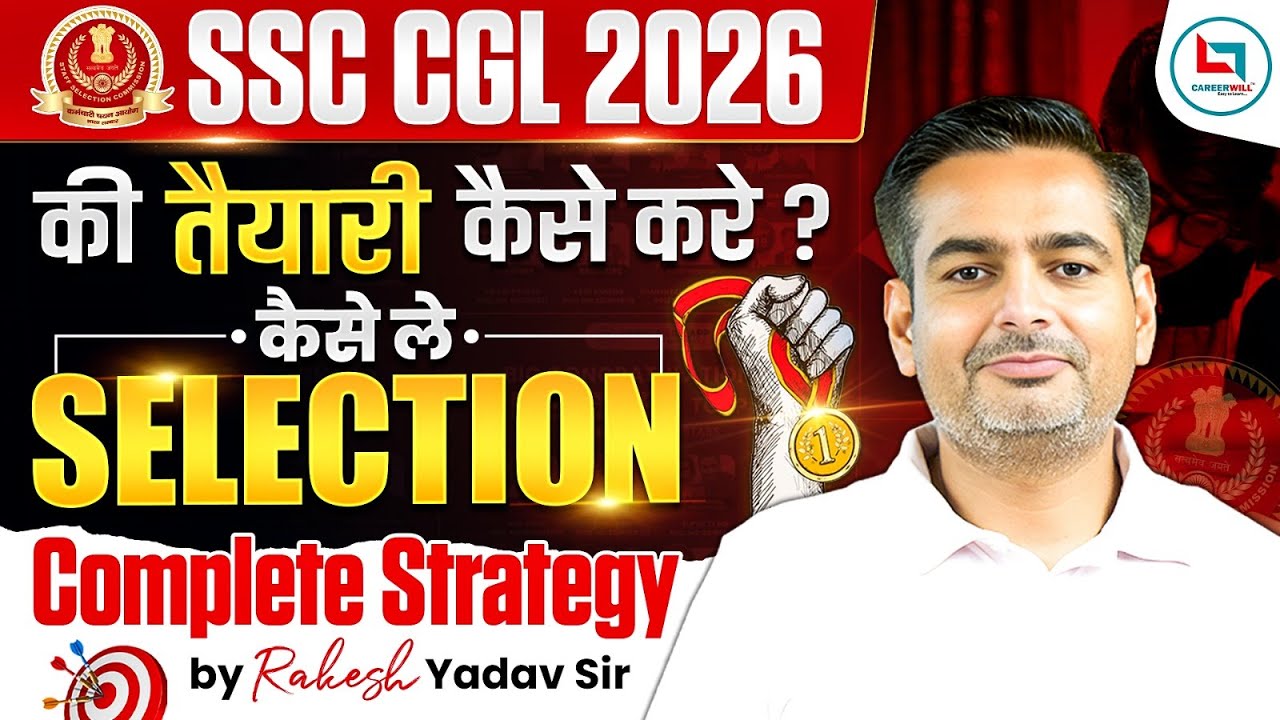
The Staff Selection Commission (SSC) is a government organization in India tasked with recruiting staff for various posts in the numerous Ministries and Departments of the Central Government and in Subordinate Offices.
Description of the Staff Selection Commission (SSC)
- Objective: The primary function of the SSC is to conduct competitive examinations to find suitable candidates for Group B (non-gazetted) and Group C (non-technical) posts across the central government bureaucracy.
- Mandate: It operates under the Ministry of Personnel, Public Grievances and Pensions and plays a crucial role in ensuring efficient staffing of the central administration.
Key Examinations Conducted by the SSC
The SSC conducts several major exams annually, catering to different educational qualifications and job roles:
- SSC Combined Graduate Level (CGL) Exam: For graduate-level posts like Assistant Section Officer, Inspector of Income Tax, Assistant Enforcement Officer, Auditor, and many others.
- SSC Combined Higher Secondary Level (CHSL) Exam: For intermediate (10+2) level posts such as Lower Division Clerk (LDC), Junior Secretariat Assistant (JSA), Postal Assistant (PA), Sorting Assistant (SA), and Data Entry Operator (DEO).
- SSC Multi-Tasking (Non-Technical) Staff (MTS) Exam: For matriculation (10th pass) level support staff positions across central government offices.
- SSC GD Constable Exam: For recruitment of Constables (General Duty) in various Central Armed Police Forces (CAPFs) like BSF, CISF, CRPF, ITBP, SSB, etc.
- SSC Stenographer (Grade C & D) Exam: For recruiting stenographers skilled in shorthand and typing.
Recruitment Process
The SSC uses a multi-tier examination process involving Computer-Based Tests (CBTs), descriptive papers, skill tests, physical efficiency tests (PET), and document verification, depending on the specific job requirements.
Candidates looking for central government jobs find the SSC exams to be among the most common and accessible pathways.
Official notifications, exam calendars, and application links are always available on the
Show More
Course Syllabus
Common Subjects Across Major SSC Exams
The primary objective-type computer-based exams (Tier 1 or equivalent) for most SSC recruitments typically cover four main areas:
- General Intelligence & Reasoning: Covers both verbal and non-verbal reasoning, analogies, similarities, differences, problem-solving, coding-decoding, and syllogisms.
- General Awareness: Focuses on general knowledge, current affairs, history, culture, geography, economic scene, general polity (Indian Constitution), and scientific research related to India and its neighboring countries.
- Quantitative Aptitude (Mathematics): Tests basic and advanced mathematical skills, including number systems, percentages, ratio & proportion, algebra, geometry, trigonometry, and data interpretation.
- English Language & Comprehension: Assesses vocabulary, grammar, sentence structure, synonyms, antonyms, idiom & phrases, one-word substitution, and reading comprehension.
Key Exam-Specific Syllabus Variations
SSC Combined Graduate Level (CGL)
- Tier 1: Focuses on the four common subjects mentioned above.
- Tier 2: Includes more advanced topics and additional modules for specific posts. All candidates take a mandatory Paper I covering Mathematical Abilities, Reasoning & General Intelligence, English Language & Comprehension, General Awareness, and a Computer Knowledge Test. Posts like Junior Statistical Officer (JSO) have additional papers on Statistics, while Assistant Audit Officer/Assistant Accounts Officer posts have a paper on General Studies (Finance & Economics).
SSC Combined Higher Secondary Level (CHSL)
- Tier 1: Similar to CGL Tier 1 but the difficulty level is based on the 10+2 standard.
- Tier 2: Includes a computer-based examination with modules similar to CGL Tier 2, plus a mandatory Skill Test/Typing Test that is qualifying in nature.
SSC Multi-Tasking Staff (MTS)
- The exam has two sessions in a single Computer-Based Test (CBT).
- Session 1: Numerical & Mathematical Ability and Reasoning Ability & Problem Solving (no negative marking).
- Session 2: General Awareness and English Language & Comprehension (with negative marking).
- For the Havaldar post, a Physical Efficiency Test (PET) and Physical Standard Test (PST) are also required.
SSC GD Constable
- The syllabus is at the Class 10th level and covers General Intelligence & Reasoning, General Knowledge & General Awareness, Elementary Mathematics, and English/Hindi language.
- Qualifying candidates must also pass a Physical Efficiency Test (PET), Physical Standard Test (PST), and medical examination.

 Bestseller